or


Results for INVENTOR: zhang hongyong AND FULL_TEXT: {zhang hongyong kanagawa jp}
Showing 1 – 10 of 322
A method of manufacturing a semiconductor film and a semiconductor device is disclosed. The method comprises the steps of: forming a non-single crystal semiconductor film on a surface by sputtering in an atmosphere comprising hydrogen; and crystallizing the non-single crystal semiconductor film at a temperature of 450.degree. C. to 750.degree. C.
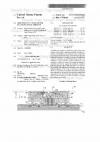
 
A semiconductor device is manufactured by the use of a glass substrate which has previously been heated. An amorphous semiconductor layer is formed on the previously heated glass substrate and then crystallized by heat. By virtue of the previous heating, shrink of the glass substrate after the crystallization process is reduced. Accordingly, internal stress is not generated in the crystallized semiconductor layer. The semiconductor device thus manufactured is superior in electrical property.
 
A channel forming region of a thin-film transistor is covered with an electrode and wiring line that extends from a source line. As a result, the channel forming region is prevented from being illuminated with light coming from above the thin-film transistor, whereby the characteristics of the thin-film transistor can be made stable.
 
An active matrix liquid crystal display having auxiliary capacitors. Two transparent conductive layers of ITO are formed on opposite sides of an insulating film. The first conductive layer forms pixel electrodes. The second transparent conductive film overlaps at least parts of the pixel electrodes via the insulating film to form the auxiliary capacitors without deteriorating the aperture ratio of the pixels.
 
The present invention related to unifying steps of sealing material so that the yield and the reliability of a liquid-crystal display device become high. A starting film of scanning lines is patterned so that prismatic dummy wirings 301 for the first layer which are not electrically connected are formed in regions R1 and R2, and wirings 302 extending from the pixel section are formed in a region R3, and wirings 303 having connection end portions 303a are formed in a region R4. After an interlaye…
 
A metal electrode also serving as a black matrix is so formed as to cover the periphery of an ITO pixel electrode. A region where the pixel electrode and the metal electrode coextend also serves as an auxiliary capacitor. Since the auxiliary capacitor can be formed by using a thin insulating film, it can have a large capacitance. By virtue of the structure in which the black matrix also serves as the auxiliary capacitor, it is not necessary to provide an electrode dedicated to the auxiliary capa…
 
Method of processing, e.g., laser annealing, objects such as semiconductor devices with pulsed lasers with high production yield and high reproducibility so as to obtain good characteristics stably. The pulse width of the irradiated pulse beam is set to more than 30 nsec to stabilize the processing. To achieve a pulse width exceeding 30 nsec, plural lasers are connected in series or in parallel and excited successively.
 
A channel forming region of a thin-film transistor is covered with an electrode and wiring line that extends from a source line. As a result, the channel forming region is prevented from being illuminated with light coming from above the thin-film transistor, whereby the characteristics of the thin-film transistor can be made stable.
 
Method of forming a crystalline silicon film having excellent characteristics. An amorphous silicon film is formed on a substrate having an insulating surface. The amorphous film is thermally annealed at 400.degree.-620.degree. C., preferably at 520.degree.-620.degree. C., more preferably at 550.degree.-600.degree. C., for 1-12 hours. The silicon film is crystallized to a crystallinity of 0.1-99.9%, preferably 1-99%. Then, the silicon film is irradiated with UV laser radiation. Thus, the crystal…
 
A semiconductor device is manufactured by the use of a glass substrate which has previously been heated. An amorphous semiconductor layer is formed on the previously heated glass substrate and then crystallized by heat. By virtue of the previous heating, shrink of the glass substrate after the crystallization process is reduced. Accordingly, internal stress is not generated in the crystallized semiconductor layer. The semiconductor device thus manufactured is superior in electrical property.
 
1 2 3 4 5 6 7 8 9 10
 
 
About |  FAQs |  Terms & Disclaimer |  Link to Us |  Contact Us